

Apple Turns 50 in 2026: How One Company Shaped the Modern World
Fifty years. Half a century. That's how long Apple Inc. has been part of our lives — and honestly, it's hard to imagine the world without it. Founded on April 1, 1976, by Steve Jobs, Steve Wozniak, and Ronald Wayne in a garage in Los Altos, California, Apple has grown from a scrappy computer startup into one of the most valuable companies in human history. And as the world marks this extraordinary milestone in 2026, it's worth pausing to reflect on just how deeply this one company has reshaped the way we work, communicate, create, and live.
This isn't just a corporate anniversary. It's a cultural moment. So let's take a deep dive into Apple's incredible 50-year journey — where it came from, what it built, and where it might be headed next.

Photo by Anastasiya Badun on Pexels | Source
From a Garage to a Global Empire
The early days of Apple were anything but glamorous. Wozniak built the Apple I by hand, and the company sold it as a bare circuit board for $666.66. It was a machine for hobbyists, not the masses. But what set Apple apart from the very beginning was a radical idea: computers should be beautiful, intuitive, and personal.
The Apple II (1977) was the first real breakthrough — a color display, a keyboard, and software that people could actually use. Then came the Macintosh in 1984, launched with one of the most iconic TV commercials ever made, directed by Ridley Scott. It introduced the world to the graphical user interface and the mouse, concepts that Microsoft would later popularize and that now define virtually every computer on the planet.
Apple's early years weren't without turbulence. Jobs was famously ousted from the company in 1985, and Apple spent the next decade struggling to find its footing. By 1997, the company was weeks away from bankruptcy. Then Jobs came back.
The Second Act: The Most Remarkable Corporate Turnaround Ever
What followed Jobs' return is arguably the greatest second act in business history. In rapid succession, Apple launched:
- The iMac (1998) — a colorful, all-in-one desktop that made computers fun again
- iTunes and the iPod (2001) — which didn't just sell a music player; they redefined the entire music industry
- The iTunes Store (2003) — which made legal digital music purchases mainstream at $0.99 a song
- The iPhone (2007) — which Jobs called "an iPod, a phone, and an internet communicator" and which proceeded to make every other phone on Earth obsolete almost overnight
- The App Store (2008) — which created an entirely new economy, generating over $1 trillion in developer billings and sales to date
- The iPad (2010) — which created the modern tablet category
Each of these wasn't just a product launch. Each one was a paradigm shift. And together, they transformed Apple from a niche computer maker into the defining technology company of the 21st century.

Photo by WeStarMoney Rec on Pexels | Source
Apple's Numbers at 50: A Company Like No Other
Let's talk scale, because the numbers are genuinely staggering:
- Apple has been the world's most valuable publicly traded company for much of the past decade
- The iPhone remains the best-selling smartphone in the United States and competes fiercely for the top spot globally
- The App Store ecosystem supports millions of developers worldwide
- Apple's services segment — including iCloud, Apple Music, Apple TV+, and Apple Pay — has become a massive revenue engine in its own right
- Apple Silicon, introduced in 2020 with the M1 chip, has redefined what laptop performance looks like, forcing Intel and AMD to dramatically accelerate their own roadmaps
And in 2026, Apple is already looking ahead. With the MacBook Neo making premium performance more accessible, rumors of an iPhone Fold swirling, and Apple Intelligence — the company's AI platform — becoming increasingly central to the product experience, Apple at 50 is not resting on its laurels.
The Cultural Footprint: More Than Just Gadgets
It's easy to reduce Apple to a hardware company. But that fundamentally misses the point. Apple didn't just sell products — it sold a worldview. The idea that technology should be elegant. That design matters as much as engineering. That the best interface is the one you don't have to think about.
Think about how Apple has shaped culture:
- Photography — The iPhone camera didn't just replace point-and-shoot cameras. It made everyone a photographer, spawned Instagram, and fundamentally changed photojournalism.
- Music — iTunes and the iPod ended the CD era. Apple Music now competes with Spotify for streaming dominance.
- Communication — iMessage, FaceTime, and AirDrop have become verbs. "Just iMessage me" is a sentence billions of people say.
- Accessibility — Apple has consistently pushed the frontier of accessibility features, making technology usable for people with visual, motor, and hearing impairments in ways no other company has matched.
- Privacy — In an era of surveillance capitalism, Apple has staked out a meaningful position as a privacy-first company — a decision that is increasingly resonant in 2026's data-conscious world.
The white earbuds of the original iPod era became a status symbol. The unboxing of an Apple product became a ritual. The Apple Store became a new kind of public square — a place people visit not just to buy things, but to learn, to tinker, and to connect.
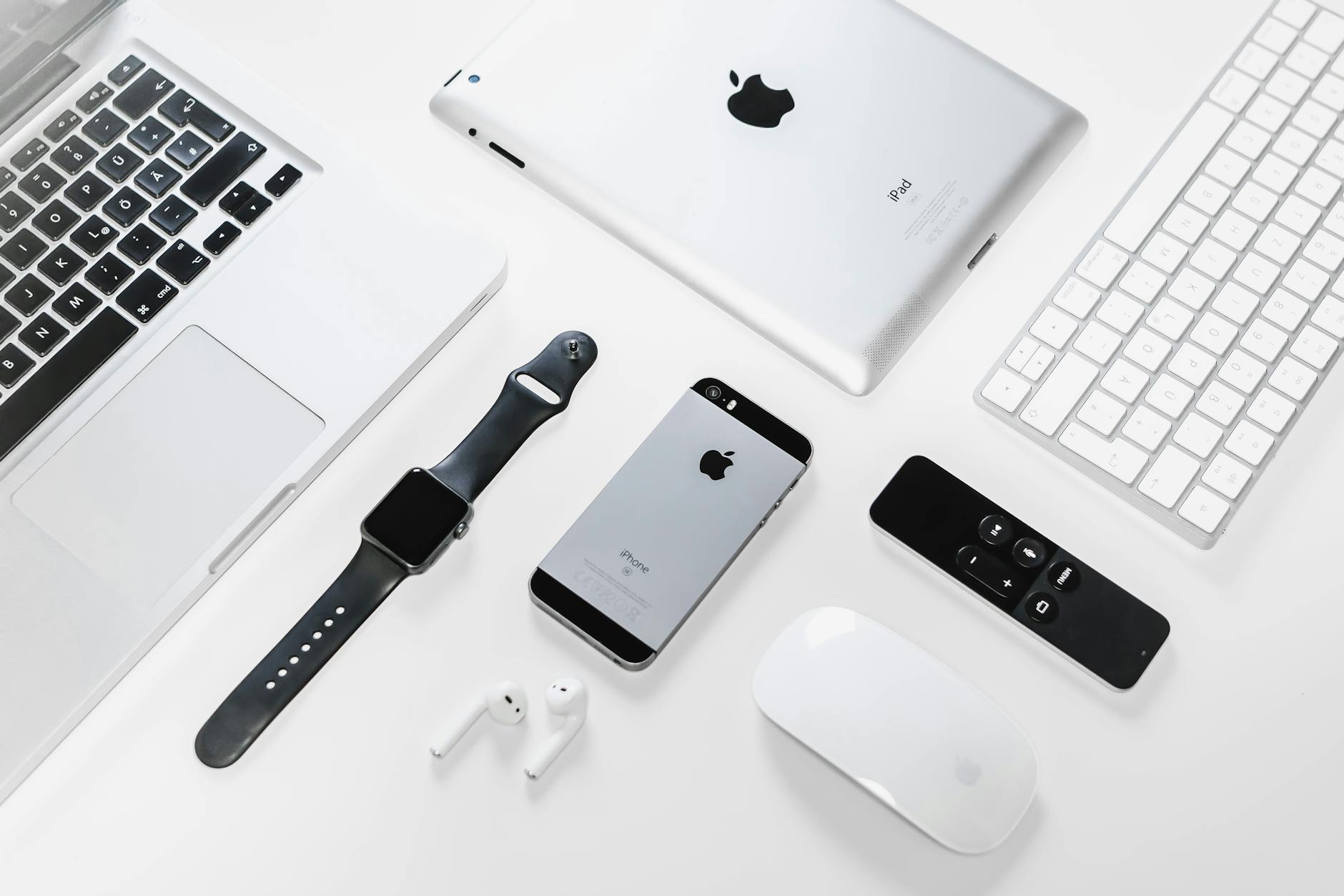
Photo by Florian Doppler on Pexels | Source
What Comes Next? Apple at 50 and Beyond
As Apple enters its second half-century, it faces both enormous opportunity and genuine challenge. The smartphone market is maturing. The AI race is ferocious, with OpenAI, Google, and a dozen other players competing for the future of intelligence. And in a world rattled by economic uncertainty — with oil above $100 a barrel and markets volatile — consumer spending on premium hardware is under pressure.
But Apple has faced existential moments before. And it has a few powerful cards to play:
- Apple Intelligence is deepening the integration of AI across every Apple device, with on-device processing that prioritizes privacy in a way cloud-first competitors can't easily match
- The iPhone Fold, if the leaked CAD renderings are any indication, could open an entirely new product category and reignite the upgrade cycle
- Apple Vision Pro and spatial computing represent Apple's long-term bet on what comes after the smartphone
- The services flywheel continues to spin, generating recurring revenue that makes Apple's business model more resilient than ever
Fifty years in, Apple is still doing the thing it has always done: looking at the world as it is, imagining the world as it could be, and building the bridge between the two.
Happy Birthday, Apple
Not every company gets to turn 50. Fewer still get to turn 50 having genuinely changed the world. Whatever you think of Apple's pricing, its ecosystem lock-in, or its occasional missteps, the verdict of history is fairly clear: the world you live in today — the way you communicate, create, consume, and connect — looks the way it does in large part because of decisions made in a garage in California half a century ago.
Here's to the next 50 years. Knowing Apple, they'll be anything but boring.
FAQ
When was Apple founded and by whom? Apple was founded on April 1, 1976, by Steve Jobs, Steve Wozniak, and Ronald Wayne in Los Altos, California. The company started in Jobs' family garage before growing into one of the most valuable corporations in history.
What is Apple's most important product of all time? Most analysts and historians point to the original iPhone, launched in 2007, as Apple's most transformative product. It didn't just create a new product category — it fundamentally disrupted mobile communications, photography, music, and computing all at once.
How has Apple performed financially at 50 years old? Apple has been among the world's most valuable publicly traded companies for much of the past decade. Its diversified revenue streams — hardware, services, wearables — have made it one of the most resilient large-cap companies in the market, even during economic downturns.
What is Apple Intelligence and how does it work? Apple Intelligence is Apple's on-device AI platform, introduced in 2024 and expanded in 2025 and 2026. Unlike cloud-based AI systems, much of Apple Intelligence processes data directly on your device, which Apple says provides stronger privacy protections.
What new Apple products are expected in 2026? In 2026, Apple is expected to launch an iPhone Fold based on leaked design renderings, expand its 'Ultra' product line beyond the Mac, and continue developing its Vision Pro spatial computing platform. The MacBook Neo has already launched as a more affordable entry point into Apple Silicon.
Frequently Asked Questions
When was Apple founded and by whom?
Apple was founded on April 1, 1976, by Steve Jobs, Steve Wozniak, and Ronald Wayne in Los Altos, California. The company started in Jobs' family garage before growing into one of the most valuable corporations in history.
What is Apple's most important product of all time?
Most analysts and historians point to the original iPhone, launched in 2007, as Apple's most transformative product. It didn't just create a new product category — it fundamentally disrupted mobile communications, photography, music, and computing all at once.
How has Apple performed financially at 50 years old?
Apple has been among the world's most valuable publicly traded companies for much of the past decade. Its diversified revenue streams — hardware, services, wearables — have made it one of the most resilient large-cap companies in the market, even during economic downturns.
What is Apple Intelligence and how does it work?
Apple Intelligence is Apple's on-device AI platform, introduced in 2024 and expanded through 2026. Unlike cloud-based AI systems, much of Apple Intelligence processes data directly on your device, which Apple says provides stronger privacy protections compared to competitors.
What new Apple products are expected in 2026?
In 2026, Apple is expected to launch an iPhone Fold based on leaked CAD design renderings, expand its 'Ultra' product line, and continue developing the Vision Pro spatial computing platform. The MacBook Neo has already launched as a more affordable Apple Silicon option.


